
Tags
American living in Scotland, creating a fictional world, fairy tales, humor, Isle of Arran, Scotland, suspension of disbelief, worldbuilding, writing
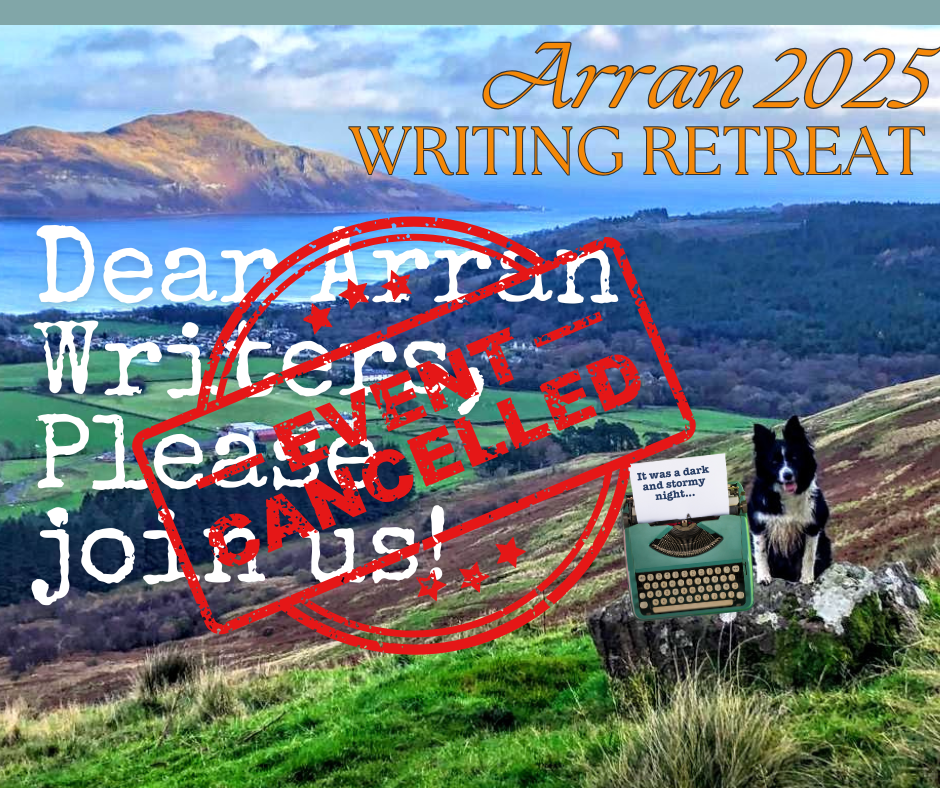
[Note from Barb: for several years, I’ve hosted a writers retreat on the gorgeous Isle of Arran off the coast of Scotland. This year, a variety of issues ranging from Covid to family emergencies led to the last-minute cancellation. So here in brief is the workshop I would have presented.]
Writing Workshop: Romeo and Juliet, Fairy Tales, and World Building
Last month I was in Verona, and passed by the house that’s been labeled Juliet’s house (from Shakespeare’s Romeo and Juliet.) It was over 40 degrees Celsius (or for us Farenheit types, 104°F) and incredibly humid. But there were hundreds of visitors obediently lined up in snake queues to visit, snap pictures of the “…wherefore art thou?” balcony, and rub the breast of the Juliet statue. As I passed by, I heard one of the tourists marvel, “How did they figure out this was Juliet’s house?” I wanted to ask her opinion of Santa Claus and the Easter Bunny, but in the interests of preserving what little international-relations credibility I possess, I held my tongue.

Fact: over three million tourists visited Juliet’s House in Verona, Italy last year to rub the boob on a statue of a 13-year-old girl who had the worst luck ever. For good luck.
Fun fact: so many tourists eagerly perved on the Juliet statue that they wore a hole in it and had to make a new one. How lucky.
In thinking about it later, though, I have to say that this is Shakespeare in top form. The completely fictional world he built for poor Romeo and Juliet to make their bad decisions in is still letting audiences suspend disbelief centuries after his play was first performed. As far as I can tell, nobody stops in the middle and says, “If Juliet was old enough to have her own mobile phone, she would just text Romeo ” Yo, 😘, 🙋’m ❌️ ☠️ for 🫀. 👤🤝👤 🙋 at the 🪦 ➕ 👉️👫’ll 🎉.”**
**”Yo, lover, I’m not dead for reals. Meet me at the cemetery and we’ll party.”
We all know there are books where the world or the setting is a character in its own right. Consider the Emerald City in Wizard of Oz, Hogwarts in Harry Potter, or the trope-defining Middle-earth in Lord of the Rings. But just as compelling are the non-fantasy worlds. Think of Agatha Christie’s Miss Marple in her village of St. Mary Mead, the rapidly disappearing American South of Margaret Mitchell’s Gone With The Wind, or the Canadian home of Anne of Green Gables on Prince Edwards Island. In each case, the author has built a complete little world, often recognizable but still with its own set of rules.
And yes, we’ve all heard how the difference between setting and worldbuilding is like the difference between weather and climate. Setting, I was taught, is like the weather: it’s what’s happening in the specific time and place where the story occurs. Worldbuilding, on the other hand, is supposed to be more like the climate: a process of defining the larger world in which that setting occurs.
I think that’s nonsense.
I would say that setting might be the immediate surroundings in the world the writer builds, but both are degrees of the same thing. Setting IS defined by the writer’s worldbuilding. As such, it might be only the barest of bones, such as a set I once saw in Samuel Beckett’s Waiting for Godot that consisted of a ladder and a stool. Or it could be Manderley, the brooding estate of Daphne du Maurier’s Rebecca, so weighted by tradition and history that its very name engulfs the present and defines the future of the never-named young bride.
The other writers in this workshop could give a master class in worldbuilding. Georgia Rose’s thriller series about the tiny village of Melton creates a setting so familiar it’s almost cozy British mystery shorthand—until we realize the village’s chocolate box façade hides an entire world seething with volcanic levels of guilt, envy, and hatred. The Granville Mill at the center of Judith Barrow’s Howarth family saga is a symbol of the history and life of the residents of a Lancashire village—first as source of jobs and income, then a darker menace as it becomes the wartime prison that dominates their lives. On a much lighter note, Darlene Foster’s intrepid young heroine Amanda immerses herself and her readers in each of the locations where she solves her mysteries. And don’t even get me started on Terry Tyler’s dystopian sagas that build our so-familiar world into epic (but still slyly familiar) destruction.
Yes, these are settings, but each one is part of a world built by its author. What makes a successful setting, let alone a believable world? Another way to think about this is to ask what goes into building a world that allows a reader to suspend disbelief in something that was never real.
There are numerous guides and suggestions out there for worldbuilding. Before I mention some of them, I’m going to selfishly begin with the only two actual rules I think we need.
Rule 1. Blogger Simon Provencher’s ‘Golden Rule’ of worldbuilding says “… unless specified otherwise, everything inside your world is assumed to behave exactly as it would in the real world.”
Rule 2. My personal corollary to Rule 1: your world needs unbreakable rules that will serve as the laws of physics for your fictional world, no matter how fantastical you make it.
Taken together, these rules mean if there’s magic, it must have specific and firm boundaries. If there are superpowers, your audience should know where they came from and what their limits are. If there’s an event that wipes out most of the world population, put some actual science around how it was developed and delivered. Establish rules for the way your world works and follow them. Even if your main character is The Chosen One, he still doesn’t get to whip out a new magic talent in the nick of time to save the day. Again. If your heroine is a medieval peasant, she doesn’t get to champion equality and justice for all (unless her name is Joan of Arc, and even then, she gets burned at the stake.)
Consider the three Gs of worldbuilding:
- Genre. Obviously, the world of a gritty damaged detective/police procedural is going to look different from a YA fantasy romance. What is your world’s culture like? What language(s) do they speak?
- Geology. What does the landscape look like? What kind of topography, weather, animals, urban areas does it have? Are there any of the normal laws of physics that don’t apply?
- Game Plan. What is the history of your world? Is it exactly what the history books show? Is it an alternate history where the dinosaurs weren’t wiped out/Atlantis exists/Hitler won/World Wars did (or did not) happen? Who is in charge? What does your world’s politics, religion, magic, government look like? How did they occur?
Why do we accept that animals can talk, magic wands can send you to the ball, or dragons can fly?
For most of us, our earliest encounters with worldbuilding are in the form of fairy tales. Some say fairy tales embody universal tropes that pass along the most basic traditions of social information and behavior. In other words, they build worlds that explain our lives:
-
- Watch out for those who are different.
- Fear the unknown.
- Obey your mother, or the big bad wolf will eat you.
- Play your cards right, and a fairy (or a prince or an enchanted frog) will rescue you.
- Follow the rules, and you will live happily ever after.
But that can’t be the whole answer because fairy tales aren’t actually all that traditional. The ones our grandchildren hear are not the same ones our grandparents told, and they bear little resemblance to their early versions. If the stories don’t change constantly, their meaning becomes irrelevant. Certainly we don’t want our children to hear that the path to true love is for a monster to kidnap and imprison a girl until she agrees to marry him. Or that a young woman can’t possibly live happily ever after unless some prince ‘rescues’ her. Or that your stepmother will always try to kill you. And maybe eat your heart… [check out If Disney Princes Were Real, from BuzzFeed]
We just have to go back and look at the original versions to see what I mean. In one of the earliest known sources for many of our familiar fairy tales, Giambattista Basile’s The Tale of Tales/Il Pentamerone (1634), Cinderella is a conniving girl who murders her first stepmother in The Cinderella Cat but still ends up marrying a prince. In Charles Perrault’s original version from Stories or Fairy Tales from Past Times: Tales of Mother Goose (1697), Little Red Riding Hood strips naked, climbs into bed with the wolf and is…er…eaten. (Contemporary 17th century readers would have understood the reference, because the term for a girl losing her virginity was elle avoit vû le loup — she has seen the wolf.) In Basile’s The Little Slave Girl (Snow White), a girl cursed to die at age seven grows to adulthood in an enchanted sleep while encased in a glass coffin, only to be awakened and enslaved by her jealous aunt.
Given the way fairy tales have evolved—you only have to take a look at the kickass heroines in modern interpretations of Cinderella such as Ella Enchanted or Ever After—it’s clearly not respect for tradition that makes us accept the magical worlds of fairy tales.
So what makes the worldbuilding of fairy tales so compelling? I think it’s the one thing fairy tales have had in common since their earliest beginnings: the ending. We’re suckers for the happily ever after – so much so that we willingly suspend disbelief in the world’s reality in order to get our HEA fix.
I think it’s that early training that prepares us to suspend disbelief as we enter worlds built by writers. What makes millions of people stand in the blazing heat so they can rub the breast on a statue of a girl who never existed? What makes grown humans learn to speak Elvish? Or secretly wait for our letter from Hogwarts? It’s all down to writers who build a world so spectacularly enticing, we willingly suspend belief in order to live in that world, at least until we reach The End.
Resources:
Worldbuilding Templates: (online fill in the blanks for a large number of world facets ranging from your world’s biology, culture, economy to morès regarding sex, politics, religion, etc.) Obviously, these are more useful if you’re building an entire fantasy world from scratch, but still useful even if your setting is your own neighborhood.
- Storyplanner https://www.storyplanner.com/story/plan/world-building-detailed-plan
- The Novel Factory https://www.novel-software.com/worldbuilding-questionnaire/
- Kindlepreneur https://kindlepreneur.com/worldbuilding-template/
- Reedsy https://blog.reedsy.com/worldbuilding-guide/
Discover more from Barb Taub
Subscribe to get the latest posts sent to your email.
 Barb Taub
That was wonderful. Thanks.
LikeLiked by 1 person
Thanks so much!
LikeLike
This would have been an awesome workshop! perhaps next year. I would not have been able to keep a straight face if I had heard the comment about Juliet’s place. Although, when I toured Green Gables, I kept reminding myself that Anne never really lived there as she is a fictional character.
LikeLiked by 1 person
Wait… Anne Shirley is FICTIONAL? [must sit down…]
LikeLiked by 1 person
Oh dear. Now I feel like the mom who had to tell her ten year old that Santa was not real. (You already knew about that, right?)
LikeLiked by 1 person
I remember when my daughter asked me if the tooth fairy was real. “What do you think?” I asked her.
She finally replied, “Not real.”
I was about to agree with her when she added, “The Tooth Fairy is probably really Santa…”
LikeLiked by 1 person
Precious!
LikeLiked by 1 person
dear God…. that was blxxxy awesome. You know what Barb? Right before I started reading this post, I meant to say: I’ll be with you in Verona or anywhere you choose, not even for the workshop/retreat but just to be in your circle…. I would be laughing most of the time, breeding some really awesome texts, make a lot of new friends… or so I thought.
Then, I read you and I have to say: It would so be not for me, I haven’t read most of the cited books, nor ever seen those films, I know next to nothing about Martha’s Vineyard and only realised late in life, that it 1. exists really and 2. that it wasn’t about wine-tasting all day and eating fabulous food prepared by the hands of Martha Steward…. and therefore, very sadly, I’ll have to refrain from joining you in a writers retreat and just retreat myself here….
btw; you’re my glorious, shining, wonderful, funny woman sister in spirit!
LikeLiked by 2 people
Dear Kiki, I don’t really know anything about Martha’s Vineyard either. Perhaps we could be ignorant together, and just go for the snarky texts and great food from the little Scottish island?
LikeLiked by 1 person
sounds good! I’d only be afraid I couldn’t leave anymore with no ferry in sight – and I’m quite attached to my family and friends over here….
Boy, would we have a great party!
LikeLiked by 1 person
We’re working on that! We now have a (little) boat, and we’re watching sailing lessons on YouTube. The dog is not pleased with her life jacket. Neither am I for that matter. But with luck we’ll be able to sail to the mainland. Or drown. (Jury is still out.)
LikeLiked by 1 person
This. Was. An. Awesome. Post. Barb, I would have loved this conference and the question about where she lived… eek.
LikeLiked by 2 people
Thank you so much Beth. And you don’t have to wait for a writing conference — you know you’re always welcome on Arran!
LikeLiked by 1 person
I may just be there. Not a threat.
LikeLiked by 1 person
Promise?
LikeLiked by 1 person
indeed!
LikeLike
Excellent, Barb. I might add that world-building should be as fulfilling as character creation. Hmmm, yes, come to think of it, setting is character, isn’t it? No matter the world you’re building, it comes with its own physicality–like each of the people you create; its own personality–again, like each member of your cast; and its own attitude, which it brings with force and causal purpose to the story you’re telling. If one thinks of it that way, instead of as a construction project, then one might find themself living in the land of World-Building Can Be Fun for Writers and Readers!
As you know, that’s the land where I like to live.
LikeLiked by 1 person
I couldn’t agree more! I love books that approach setting as one of the main characters.
LikeLiked by 1 person
Barb, may I send you Extraterrestrial Noir, my new book? I think you might have some fun. The setting is the suburbs. With a film noir space alien. And all the dark comic chaos I love so much.
LikeLiked by 1 person
Thanks for the update. You know I love your books! But I didn’t know you had a new one out. I just downloaded the kindle version of Extraterrestrial Noir and look forward to reading it.
LikeLiked by 1 person
Always so happy to know you’re reading me, Barb!
LikeLiked by 1 person
Thank you for the mention, Barb :) and still annoyed to have missed out on this trip. This workshop would have been terrific.. next year!!!
LikeLiked by 2 people
I can’t wait!
LikeLiked by 1 person
Fabulous, Barb. Next year … next year!💜
LikeLiked by 1 person
🙏! Next year, weather and ferries permitting.
LikeLiked by 1 person
Really good ‘rules for the road,’ Barb, with a little of your humor thrown in!
Why do you always travel where the heat is incredible? You must be drawn to it!
LikeLiked by 1 person
We did live in some desert places when I was growing up. (You haven’t lived until your toothpaste and bar of soap melt. Again.) That might be why I now live in a place where—on that one day a year the temps reach 70F—the local FB pages are full of reminders to sunblock the pigs.
LikeLike
Now that’s something I’m not familiar with. Perhaps you live where you do as relief from all the hot places you are drawn to!
LikeLike
Wonderful 😘
LikeLiked by 1 person
Thank you!
LikeLiked by 1 person
Fabulous, Barb. You make some excellent points. Fairy tales are as popular today as ever. I often tell the children at school the stories, no pictures or books, just the words. Sometimes I invent my own fairy tales, such as Goldilocks and the Three Dinosaurs. As to animals, children can see themselves in animal stories, not in people stories. I call that the ‘indirect method’, and it allows children to understand emotions. Here’s hoping the writer’s retreat happens next year. Darlene Foster had the best time with you!
LikeLiked by 1 person
I noticed that my own children were both amazingly literal—only seeing themselves in my stories if I actually included them as named characters—and completely willing to believe in talking animals, magic wands, and any other deviation from a world that was showing them new things daily. They didn’t have to suspend disbelief, because as far as they could tell, their world already contained a talking monster who lives in a trash can, a vampire who likes to count things, lights that come on at the flick of a switch, magic screens that let them talk to family and friends across the world, and so much more. Santa and the toothfairy gave presents as real as grandparents on the other side of the country.
It’s only as adults that we have to work to suspend disbelief in the worlds writers build. My kids totally believed in Hogwarts, Star Wars, and spiders who could spell with their webs. I want to be the writer who can build those worlds, and the reader who can suspend disbelief while in them.
LikeLiked by 1 person
Beautifully said, Barb! This is eloquent and poignant. I totally agree! BTW, you are that writer and reader.
LikeLike
Excellent post, Barb, and thanks for the mention! I love that video!
LikeLiked by 1 person
Thanks Terry!
LikeLiked by 1 person
Ethereal perspective
LikeLiked by 1 person