
India trip route: by boat, train, plane, taxi, autorickshaw, and the kindness of Indian strangers.
(Part 1 is here if you missed it.)
“Breakfast,” said the polite voice at on the phone in our hotel room in Gwalior. “It is ending soon.” After Janine almost got third-degree burns from the scalding hot shower, I remastered my bucket shower skills. Mostly clean, somewhat fed, and barely awake, we stumbled out to meet our driver.

As a rule of thumb, I’d say the great divider between 3-star and 4-star hotels in India is the bucket (and the scoop).
Because we were making the connections by train and plane, this is the first trip where we did not hire a car and driver to accompany us for the majority of the trip. Kamini, concierge for our hotel and our new best friend, convinced us to book a car for the day as the autorickshaws would find it difficult to make it up the steep road to Gwalior Fort.
The three of us still have PTSD after a trip to Hampi when our portly driver—aptly named for Ganesh, the elephant-headed god—informed us that his machine couldn’t make it and we would have to walk the rest of the way up the mountain. So hiring the car and driver seemed a good move.
NOTE: (I’ve really got to do a post on Indian drivers for hire, but suffice it to say here that we named this one Mr. Talky-McTalky Face because he never stopped yakking on his TWO mobile phones as he drove.)
The first place Mr. Talky took us was the relatively new Sun Temple, a conscious homage to the original 13th century temple in Odisha, India. They don’t allow any cameras or photography at the new Sun Temple, so I can’t show you a photo. But if you have already seen the original at Konark, I have to say I would give the new one a miss except for two things. The first is the staff at the new one, who are proactively kind. When Jaya and Janine took the stairs up to the temple, I decided to remain below to avoid straining my bad knee. But an attendant noticed me and brought me around to a special stairlift, allowing me to view the temple. The other thing is that when we were (admittedly slowly) climbing the steps of the original Konark, another visitor (obviously an American, as we seem to enjoy publicly embarrassing ourselves and others) announced that ‘old ladies shouldn’t be allowed’ on the monument.
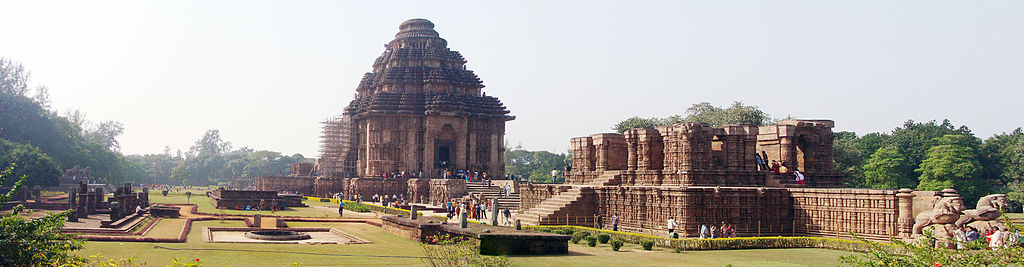
Original Sun Temple at Konark, Odisia. (My post on the original Konark Sun Temple is here.) [Image credit: Wikimedia Commons]
From the Sun Temple we headed up to the massive Gwalior fort, which dates from the fifth century CE and stretches more than five kilometers along the ridge above Gwalior city. On the way we passed 14th-15th century monumental sculptures, (40-50 feet tall) carved into the mountain and representing the Tirthankaras (Jain saints). Just before the Fort, we stopped at the Gujari Mahal Museum, originally a palace built by Raja Mansingh Tomar for his beloved queen Mrignayani.
I wanted to view the 10th century statue of the goddess Shalabhanjika, also known as the Mona Lisa of India. She’s kept in the curator’s office, safe behind her metal grate and reinforced glass. We were shown into the office, where we had a private view of the goddess and her enigmatic smile. But it was the unusual and romantic story of the palace’s first queen that captured my imagination.
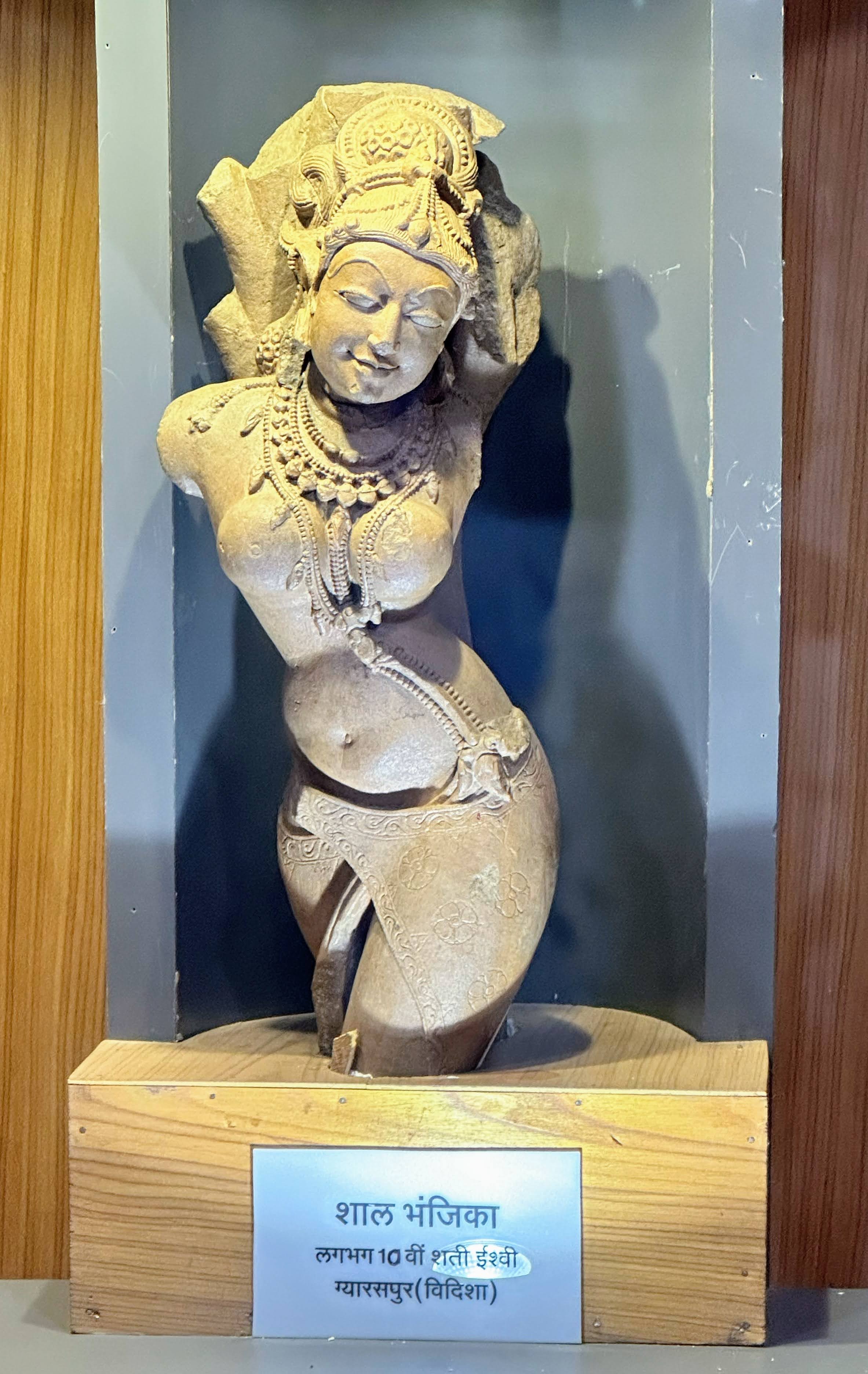
The Indian Mona Lisa, a stone carving of the goddess Shalabhanjika, is located in the Gujari Mahal Museum in Gwalior Fort. [NOTE: unless otherwise indicated, this and all other photos in this series are © Jayalakshmi Ayyer and Janine Smith, 2025.
A Fifteenth Century Feminist Love Story
Mrignayani was a young woman known for both her beauty and for her bravery in fighting off an abduction attempt. Raja Mansingh Tomar was a warrior king who ruled Gwalior from 1486 to 1516. He was also a patron of the arts, especially music, and his court included the great musician Tansen (after whom our hotel was named). Already intrigued by the stories about her, the king was out hunting when he saw Mrignayani subduing two enraged buffalo. Unable to sleep without dreaming of Mrignayani, Raja asked her to marry him. But Mrignayani, who had her own ideas about her future, made three demands of the besotted king. First, she would not wear purdah (clothing that hides the face and body and/or residence where no men can view her) as was the custom with royal wives, but instead would always be with him, including fighting at his side in battles. Perhaps aware of her fate at court as a lower caste than the king’s other eight (!) wives, her second demand was that he build her a separate palace. And finally, she requested a 16-kilometer long pipeline to bring water from her village to the new palace. He agreed, and the legend is that they had two sons, fought several battles together, and build a court famous for the arts and especially music.
Gwalior Fort
We walked around the outside of the Manmandir Palace, where Janine took a million pictures of the inset tiles and carvings plus the view because she thought that was all we were allowed to see. We admired the view, posed for pictures with Indian children, and figured out that the oldest recorded use of the numeral zero was inscribed there. Jaya finally tracked Janine down and explained that we hadn’t even gone inside yet.
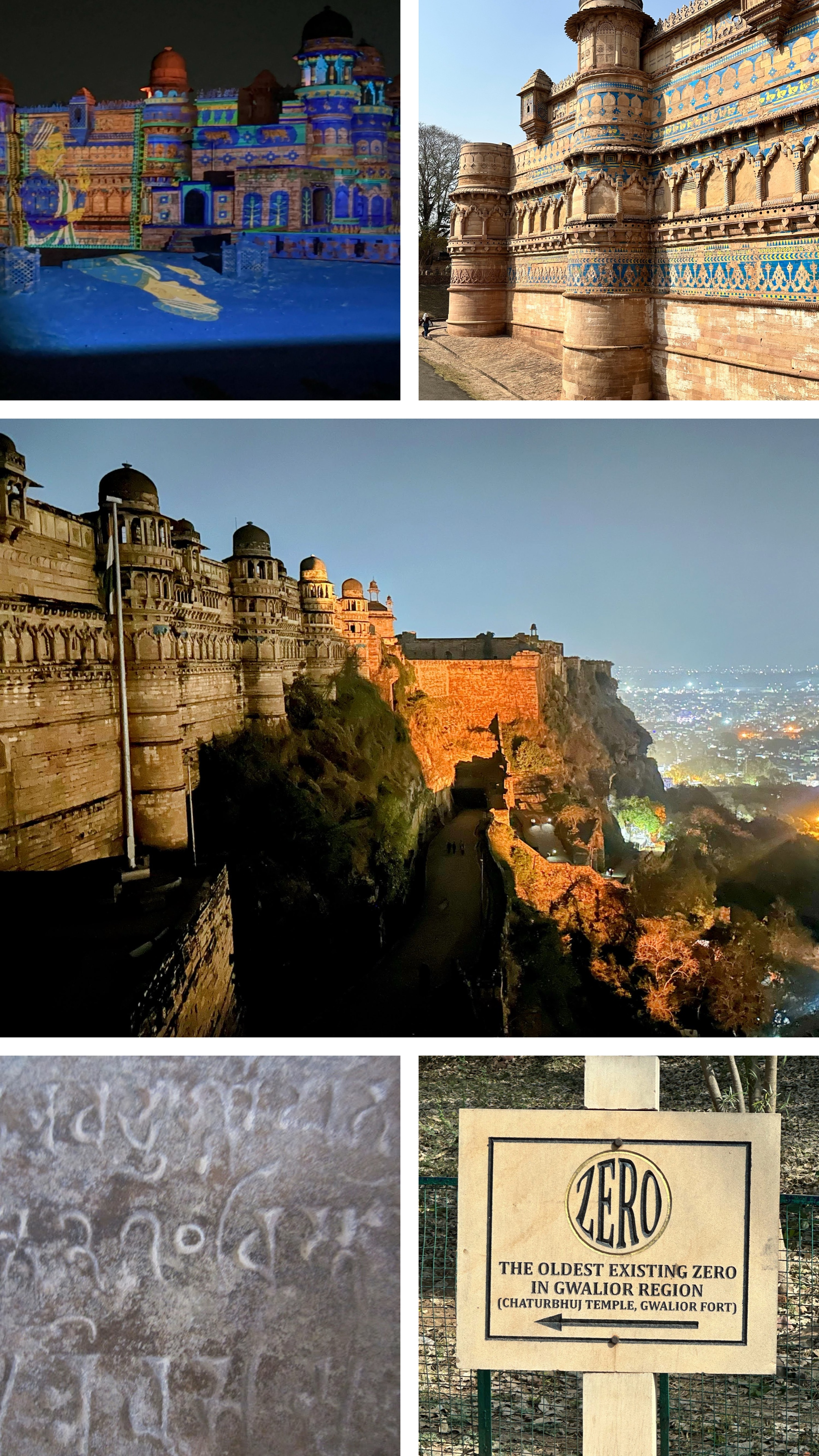
GWALIOR FORT
Top row: Left: Sound & Light show on walls of Gwalior Fort. Right: Walls with inlaid lapis tiling.
Middle: Gwalior Fort at night.
Bottom: left: Oldest known use of zero as a numeral. right: sign
We spent the afternoon visiting temples. First up were the Sas Bahu Temples. This pair of ruined temples known as the mother-in-law/daughter-in-law were built between 1090 – 1093 by King Mahipala of the Kachchhapaghata dynasty. The larger one (Sas) was constructed for his wife and the smaller one (Bahu) was constructed for his daughter-in-law. Their location was stunning, with a panoramic view of the entire valley spread below.
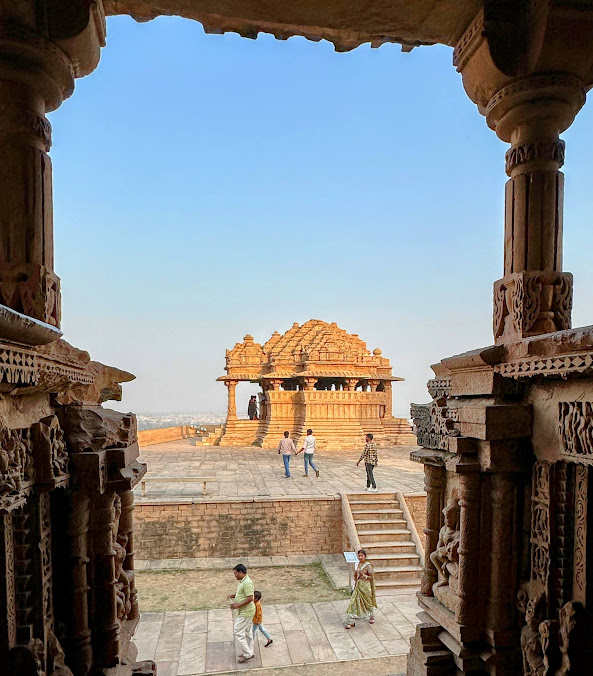
Sas Bahu Temples, Gwalior. (view from the mother-in-law to the daughter-in-law)
Our next stop was Teli Ka Mandir a (ruined) ninth century tower temple.

Teli Ka Mandir, a ruined 9th century temple and the highest point at Gwalior Fort.
From there we could see a beautiful white temple. When we asked about it, we were told it was a Gurudwara (Sikh Temple) and decided to visit. Before entering, we had to check our shoes into their storage, wash our hands, and walk through a long foot bath to clean our feet. Inside we found an open, airy temple. We went up to see the glass-walled room in the center, with three people seated on the floor behind a huge book covered in a sparkly cloth. Jaya explained that Sikhs consider their holy book, the Guru Granth Sahib, is venerated as a living guru. There was a huge collection of swords and weapons arranged in a beautiful deadly design in front of the book, a reminder that Sikhs consider themselves warriors. (Janine was in agony, as photos were not allowed.)
It was getting late and we debated whether to go back to the fort for their sound and light show, but in the end decided to give it a shot. We were waiting for show to start, so Jaya decided to take some photos. She’d just got to her feet when a gigantic voice from the heavens bellowed for her to be seated. Jaya froze, deer in the headlights, and scuttled back down.
The show, projected along the face of the Manmandir Palace, was simply breathtaking. Somehow the tree next to the palace acquired a face, which narrated the history of battles, bloodshed, and triumphs, accompanied by music and sound effects. The dusty ground in front of us was transformed into a lake full of fish and creatures from myth and legend, leaping and frolicking. The walls were a moving mural of history and stories that we were still marveling about as we headed down the mountain and our beds.
[Gwalior Fort light show]
Discover more from Barb Taub
Subscribe to get the latest posts sent to your email.
 Barb Taub
Sounds fascinating and so clever with the light show.
LikeLiked by 1 person
Thanks, Rosie! We’re having a fabulous time.
LikeLike
Wow! What an incredible experience. I love the story of Mrignayani, proving that there have always been kick ass women around. The light show must have been something else. Thanks for the detailed report and fab photos.
LikeLiked by 1 person
Thanks Darlene. Amanda would love it here!
LikeLiked by 1 person
She would!!
LikeLike
I bet the other wives wished they had made some demands before marrying him – ‘Why didn’t I think of that?’
LikeLiked by 1 person
I often wish I could go back and write “I vow not to clean toilets” into my marriage vows.
LikeLiked by 1 person
I love this leg of your trip. the divine miss M and her demands are stunning and it sounds like she was wise and well as beautiful. and zero! wow, it seems they saw zero zeroes prior to this one!
LikeLiked by 1 person
I know, right? Turns out the discovery of zero changed the course of history.
LikeLiked by 1 person
who knew? zero people knew until that moment.
LikeLike
You crowded a lot of stuff into one day – beauty and history. Love to be taken along!
LikeLiked by 1 person
We realized that we end all days on this trip with one of us sighing, “What a day!” We honestly can’t believe how much we’ve seen and how incredibly much is still waiting to be experienced. Talk about lucky!
LikeLike
I love these visits of yours to India. The descriptions and pictures bring it vividly to life and I get a glimpse of the awe and wonder. I also loved ‘old ladies shouldn’t be allowed on the monument’. Terrific!
LikeLike
I agree with that!
LikeLike
I loved this post, as your visit was full of adventure and history, laced with your great humor. The feminist story was terrific, and the forts and temples are gorgeous. And zero? Wow.
LikeLike
Pingback: Really 2025? Give it a rest! | Barb Taub